
"Spirituality" at ASU
I am one with the universe

An ASU Humanities Institute advertised an event where students will learn to be “mystics.” This is standard for ASU when it comes to religion. ASU offers “meditation” and “yoga” classes to help with stress and health. Here, “meditation” means transcendental meditation—clearing your mind of all thought to connect with “The One.” You won’t find them practicing meditation as described in Psalm 1:2: “I meditate on the law of the Lord day and night.”
This “mysticism” event is no exception. Students will be taught how to free themselves from the confines of ordinary existence. According to the event description,
“A rough and ready definition of mysticism is that it is a way of systematically freeing yourself from your standard habits, your usual fancies and imaginings, so as to see what is there and stand with what is there ecstatically. Mysticism is the practical possibility of the achievement of a fluid openness between thought and existence.”

Such mystics teach that “all is one” and that our “ordinary” lives are an illusion to be overcome. They deny there is any difference between the “self” and “God,” and so the purpose of their guided mystical meditations is to make you realize your oneness with God. Your true self, they say, is God. It is meant to make the student question distinctions such as “good and evil” and “right and wrong.”
Does that sound familiar? Perhaps straight out of the serpent’s mouth in the Garden of Eden: “You don’t have to obey God—you can be as God yourself.”
The Center for the Study of Religion and Conflict is paying big money to Simon Critchley to teach students how to become one with everything. Critchley identifies with left-wing political theory rooted in continental philosophy—particularly Marx, Derrida, Levinas, and anarchist thought. His approach belongs to what’s often called the post-Marxistor continental left—along with figures like Alain Badiou, Slavoj Žižek, and Ernesto Laclau.
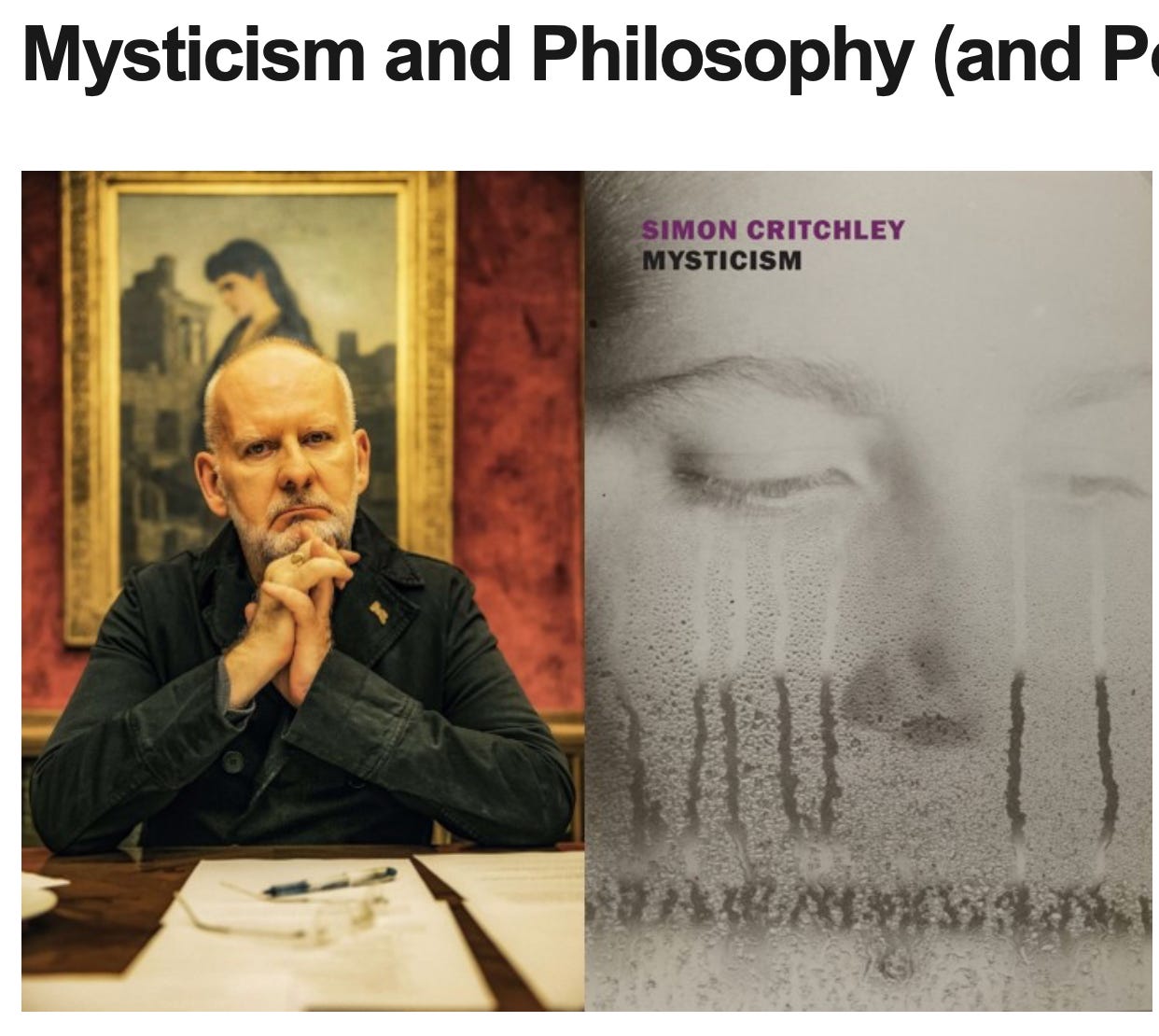
Pure materialistic atheism is rarely satisfying. You’ll almost always find atheists like Critchley searching for a “mystical experience” of “oneness” to justify their existence. But here’s the philosophical problem: if all is one, then good is evil. There are no real distinctions of any kind in “the oneness.” In fact, being “one with everything” is logically identical to not being one with anything. It is nonsense. Which is why they ask you to go beyond all cognition and rational thought to have “experience in its most intense form.”
Instead of teaching their students how to use logic to identify unsound arguments, ASU’s Center for the Study of Religion and Conflict has launched its “Spirituality and Public Life” series to promote Critchley and similar thinkers. When will they invite a Bible-believing Christian to speak? If you ever see a “conservative” on the program, it will likely be a leftist-approved conservative—someone like Jeff Flake.
It would be worthwhile to find out exactly how much ASU paid Simon Critchley to speak. I don’t know if that requires a FOIA request or simply an email to the head of the department—but it’s worth asking.
If you’d like to help the reformation of our public universities, please subscribe here and share with your friends and family.
Sounds downright gnostic to me.