
Returning from India
and Land Acknowledgement New College

I’m returning from eight days teaching philosophy for ASU in India. We visited three universities across the country, from Delhi to Chandigarh to Hyderabad. It was a life changing experience. At each university I taught three sessions of two hours each and then had lots of extra time with students, professors, and administrators. I have many stories to share with you.
In these sessions we covered questions such as What is Reason, What is Eternal, and What is Good? Then we asked additional questions such as Why is There Evil and What is Redemption? The students were fantastic. They were very engaged and asked thoughtful questions each of which demonstrated both curiosity and having already done solid reading in philosophy, religion, and literature. They were also very respectful, standing when a professor enters the room and not sitting until given permission to do so.
In this picture below, you see me with a group of students talking after class. They had already been in six hours of philosophy lecture (Socratic style) with me and stayed afterward for another hour. If you could hear our conversation, you would hear them saying things like, “Dostoyevsky showed us . . .,” “I think Plato meant . . .,” “I can relate to Kafka about . . ..” In this image (which is not staged, it is an authentic moment) I am explaining how the Book of Job addresses the problem of suffering and points to redemption.
We also got into fascinating conversations about AI and its role in life going forward. Can AI simulate a good human life? This is why each of the three universities have a philosophy/ethics requirement: they want their students to think about the big questions and how our answers to those questions shapes what else we do and achieve.
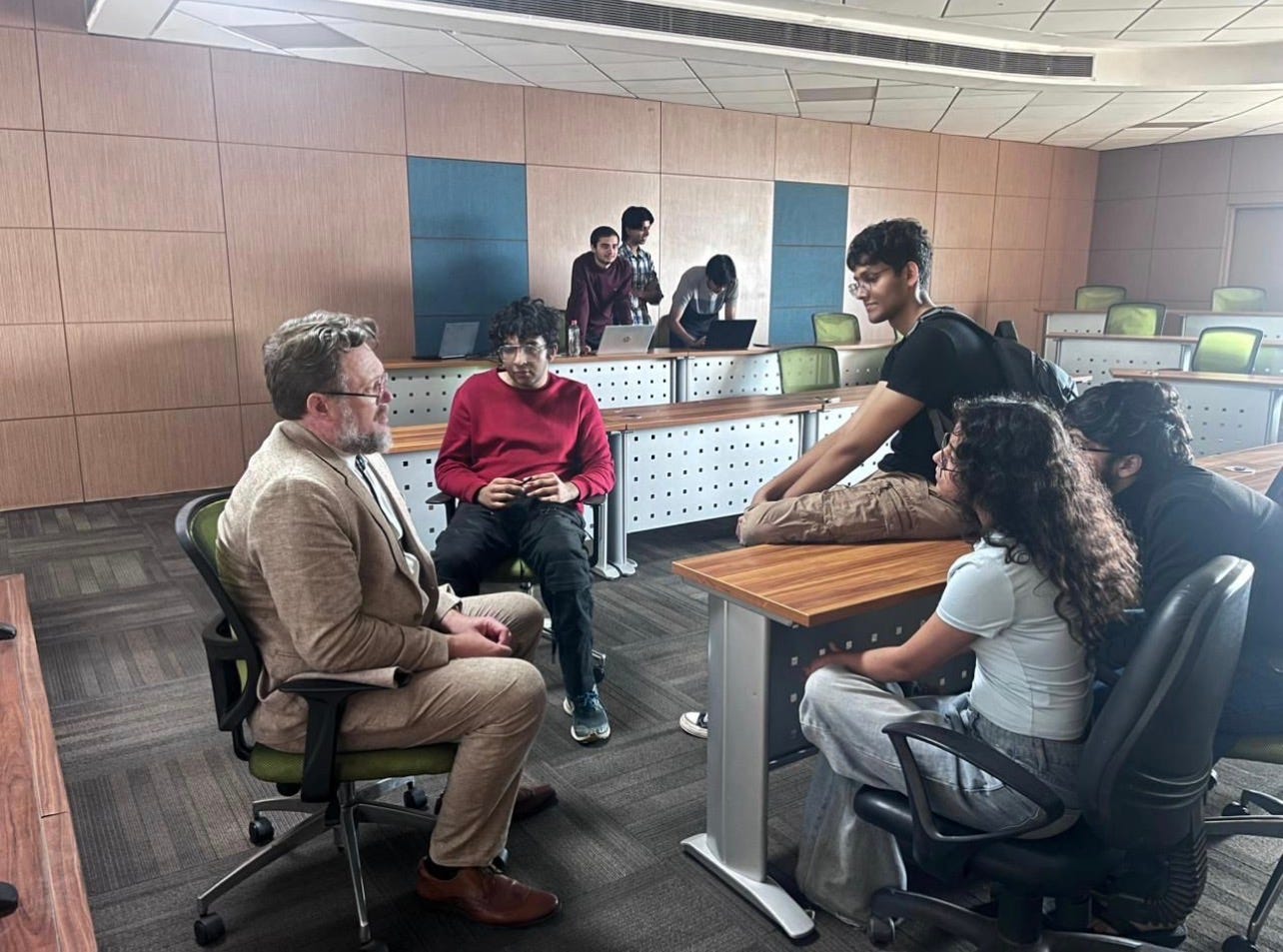
This was ASU’s first trip to India under its global initiatives program and I am the first professor to be there in person to represent ASU. In other countries it is usual for the ASU representatives to just visit one university. We visited three. It was a week of non-stop activity and it was worth it. I am encouraged that universities in India wanted to hear from a philosopher and thankful that ASU is making programs possible where philosophy is such a key discipline.
Next up: New College will vote on March 31 about whether to continue its “Land Acknowledgement.” I motioned that we end all politicizing of our business meetings. I want this vote on record so that if the faculty votes to continue making our meetings political with “Land Acknowledgments” I can take it to the next level and show that our faculty voted to violate ASU’s policy manual. In my next post we will analyze the argument given to New College’s faculty by a professor who wants to continue the “Land Acknowledgments.” A little hint: it is a great example of circular reasoning and can be used in logic classes about fallacies.
I too have had the privilege of teaching in various communities in India. My time in Hyderabad was an especially blessed time. Thank you for sharing your journey, Dr A