
President Crow Replies

I wanted to follow up on my post about President Crow’s article on the future of the American university. As I told you there, I sent him and his two co-authors an email with the reply essay I posted for you to read.
President Crow sent me a very gracious and kind reply. I haven’t emailed him many times in my career at ASU, but when I have, he has always been responsive, and I’ve received a reply to emails.
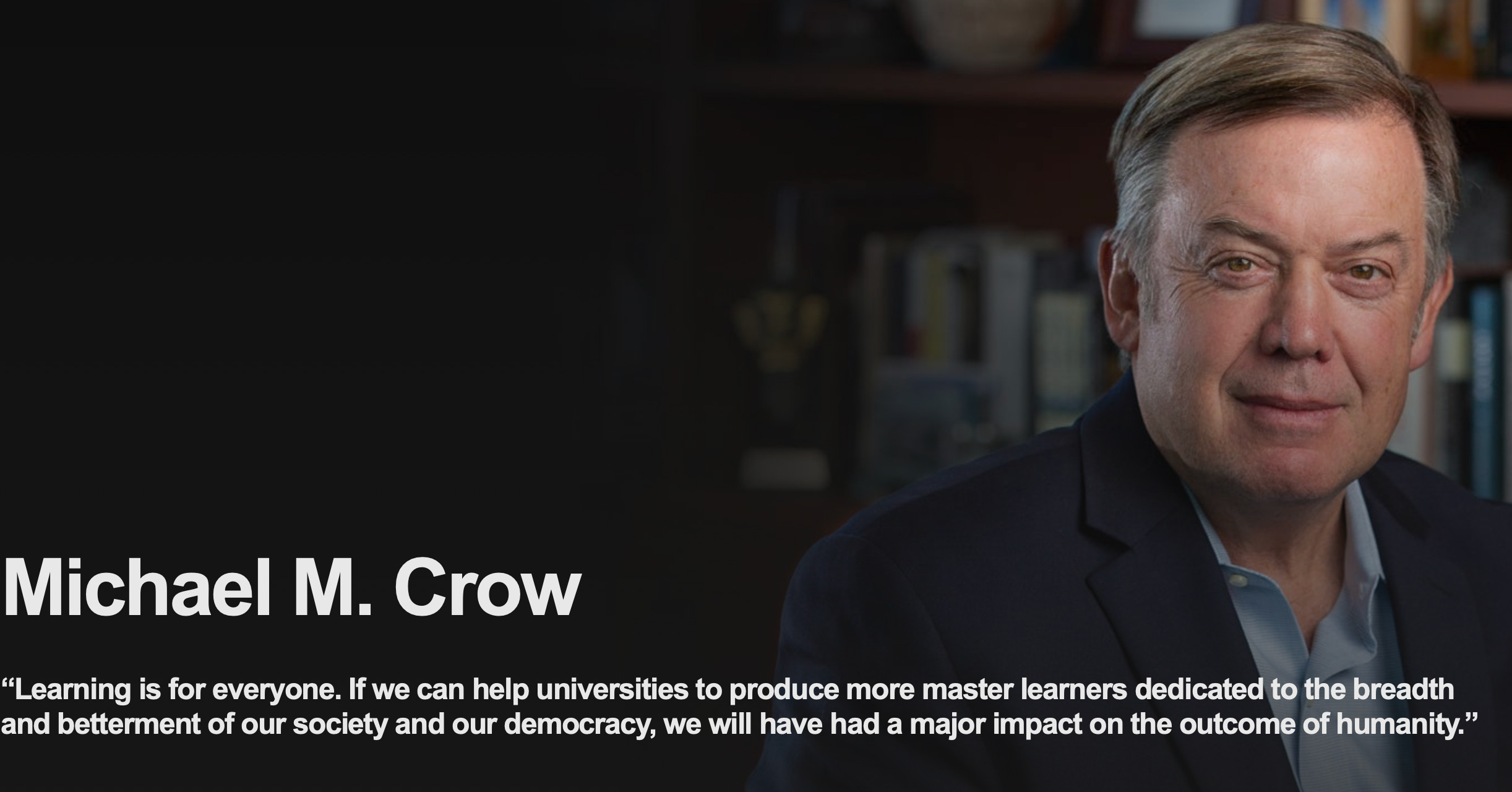
For instance, very early in my tenure-track job, I saw him at a faculty meeting and we chatted briefly. He asked me to send him a copy of my syllabus. Needless to say, that’s nerve-racking for a young, untenured faculty member. But I did send it to him, and he wrote back with comments showing he had spent time reading it. He congratulated me on having a good syllabus and encouraged me as a teacher reaching ASU students. I’ve always remembered that, because the president of the largest state university in the country took time to encourage an assistant professor of philosophy (not exactly a glamorous or high-profile field).
A number of years later, at a faculty senate meeting—when I was the faculty senate president for my campus—President Crow started a conversation with me about philosophy. Again, it was another example of his showing personal interest in a faculty member. He told me that he follows the philosophy of American pragmatism and named a few of the pragmatists he especially likes.
In his reply email to my essay, he thanked me for my ideas about the American university. He confirmed what I know, which is that the process of faculty debating and sharing their ideas can be difficult, but that it is essential. Free debate must happen so that ideas can be synthesized and tested. It is that process which the university must protect.
The email thanked me but didn’t invite further conversation, so I’ll put my ideas here.
Two ideas came to me.
First, to protect that process doesn’t mean anything goes. For instance, we have faculty at ASU who teach students to hate other students based on skin color and sexual preference. They call it “whiteness” and “heteronormativity.” We don’t accept that in most areas of society, and we should not accept it—or pay for it—in this case. Professors who want to teach students to hate each other based on identity politics are free to do so on their own dime, but they should not expect the state university to fund their hatred. Additionally, a professor who has such a heart of hate is in no place to help students learn to be good and wise.
Second, there’s the idea of a Hegelian process toward progress. The American pragmatists inherited “process” and “progress” ideas from Hegel and adapted them to the more materially focused American society. Conflict leads to synthesis, and then new conflict leads to new synthesis. We are ever getting better but will never arrive. It’s like an asymptotic curve that gets closer and closer but never touches the other line.
In the Hegelian system, nothing is transcendent. All is one, all is process. The American pragmatists assume this same framework. But the case I made to President Crow is that humans require the transcendent to have meaning in life. Our students who take humanities classes either as a major or as a general education requirement should be able to demonstrate greater knowledge of the transcendent and how that applies to their own lives.
My essay offered a different approach by which we can measure progress. Yes, we will always be finite, with more to learn. But it’s also true that we can tell whether a student is more wise after four years at ASU. One simple measurement: do they hate their neighbor because of skin color? Then they are less wise. Another measurement: can they articulate what is good for a human in more detail than when they arrived? Then they are more wise. Or consider this: a student should be able to explain what is transcendent, why it matters to a meaningful human life, and how they will apply what they have learned. Those aren’t exactly high standards, yet due to the darkness and confusion of our day, they seem like Mt. Everest.
I am thankful to President Crow for his reply and his willingness to engage in philosophical discussions about the university. I hope he continues to protect free debate from faculty who want to pull us back into the ugliest forms of identity politics and racial hatred.
I’ll be back to report on our faculty meetings coming up very soon. Can administrators keep them focused on faculty business, or will they remain the personal pulpit for the political opinions of those in charge?
It is both commendable and wise that you don't bash the president, though happily it seems he didn't give you reason to. The fact that you're supposed to be the extreme one that all of "them" are fighting is so amusing when you are the only one who seems to even want to come to the table and have a rational discussion.