
Manifesto writing

We see that the horrible school shooting today was committed by a person who appears to have identified as “trans” and left behind a “manifesto.” We saw something very similar at the Covenant School shooting in Nashville in 2023. Then, the “manifesto” was withheld.
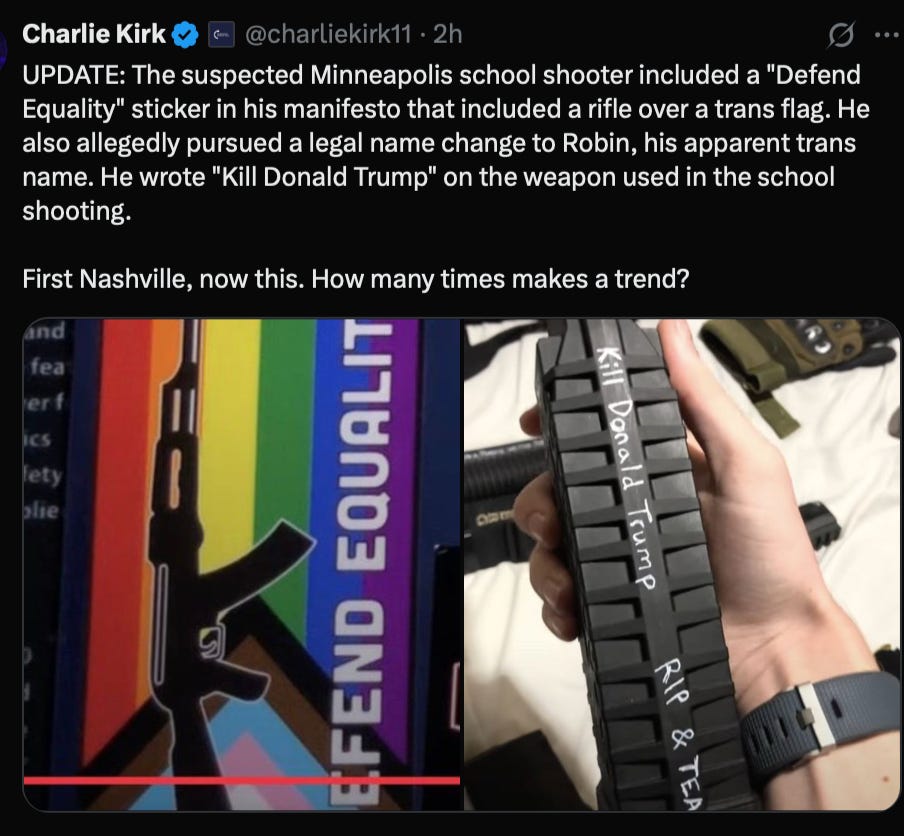
So what exactly is a manifesto? It used to be a generic term meaning a political statement of policy aims. For example, James I of England issued foreign policy statements sometimes described as manifestos.
But after Karl Marx and Friedrich Engels, the term became strongly connected to communism. They wrote The Communist Manifesto (1848), which laid out a philosophy of history that still undergirds much of modern university humanities curricula. It taught the materialist dialectic, which views history as a conflict between social classes (and later was applied to races, genders, etc.). This “conflict theory” is often what you will encounter in a university humanities classroom.
Professors trained in this outlook tend to view the world through the lens of oppressed versus oppressor. Even if they do not explicitly teach Marxism, their framework is this Marxist dialectic: ask them how history unfolds, and they are likely to frame it in terms of power struggles. In that system, the “oppressed” are by definition the good guys, and the “oppressors” are the bad guys. Students are sometimes taught to write a “manifesto” that casts themselves as oppressed and to identify the guilty, oppressive, structurally biased system to blame.
Later conservatives, such as Francis Schaeffer, wrote their own Christian Manifesto (1981). But they chose that title precisely because the word had been associated with Marxism—it was their counterstatement against godlessness in government and society. The conflict is between good and evil, between those who know God and his moral law and those who hate God and his moral law. Still, if you simply say “manifesto,” it is the communist one, not the Christian one, that most people think of.
There is a therapeutic aspect to the “manifesto writing” you will find. Sometimes students or faculty are even asked to bring their own manifestos and read them aloud. A social scientist could conduct a research project on the content of these student manifestos to see if they include the following features:
A conflict theory of history.
An oppressed/oppressor dialectic.
The author identifying as oppressed or marginalized.
Blaming “the system” or “the environment” for one’s problems.
A proposed plan to “deconstruct power.”
A failure to take personal responsibility.
The underlying theme is often resentment: teaching students to see themselves as victims, to blame their neighbor, and to shift responsibility onto structures.
In this way, these “manifestos” function as a kind of therapy. They allow the author to “come to terms” with their situation by convincing themselves it isn’t their fault. The manifesto author then demands an audience to hear their manifesto as part of the therapeutic process. The rest of us are expected to listen, sympathize, and give affirmation. There is no exercise of critical thinking, such as: “in line three, where you blame the heteronormative power structures, you fail to note your own connection to heteronomravitiy (you, and everyone else, had a mom and a dad).”
Parents and taxpayers, how much are you willing to pay for state university classes on manifesto writing? What if your child comes home after the first day of class and reports that the professor spent the lecture talking about how hard life is under the Trump presidency? Maybe you should write a manifesto of your own about the tyranny of this curriculum.
Another issue hinted at in your article is the co-opting and redefining of words. Marx and Engels chose "manifesto" intentionally to muddy the term and cause confusion. They were well aware that manifestos were political statements in their era, and by putting "manifesto" in their title, they essentially destroyed the boundary between philosophy and politics. Or at least clouded it. Which is a common tactic for Marxists now because they perceive boundaries as the weapon of the "oppressors." Chaos is the goal; resentment is the tool; stripping everything of meaning is the process.
Amen, Doc